Dr. Akila S Murthy
Jun 25, 2026
Are you listening to anxiety or intuition?
Learn how psychology, astrology, and palmistry can help you distinguish fear from inner wisdom, reduce overthinking, and make confident life decisions.
"What if I make the wrong decision?"
"What if this relationship doesn't work out?"
"What if I fail?"
"What if something bad is about to happen and I just don't know it yet?"
If you've ever found yourself caught in an endless cycle of worrying thoughts, you are far from alone. Many people spend hours replaying conversations, second-guessing decisions, imagining future problems, and searching for certainty in situations that are inherently uncertain.
One of the most common questions people bring to me during astrology consultations, palmistry readings, and psychological counselling sessions is this:
"How do I know if this feeling is my intuition or my anxiety?"
It is an important question because both can feel convincing. Both influence our choices. Both affect our relationships, careers, finances, and emotional wellbeing.
Yet they come from very different places.
Anxiety speaks through fear.
Intuition speaks through awareness.
Learning to distinguish between the two can help you make clearer decisions, reduce emotional exhaustion, and build greater trust in yourself.
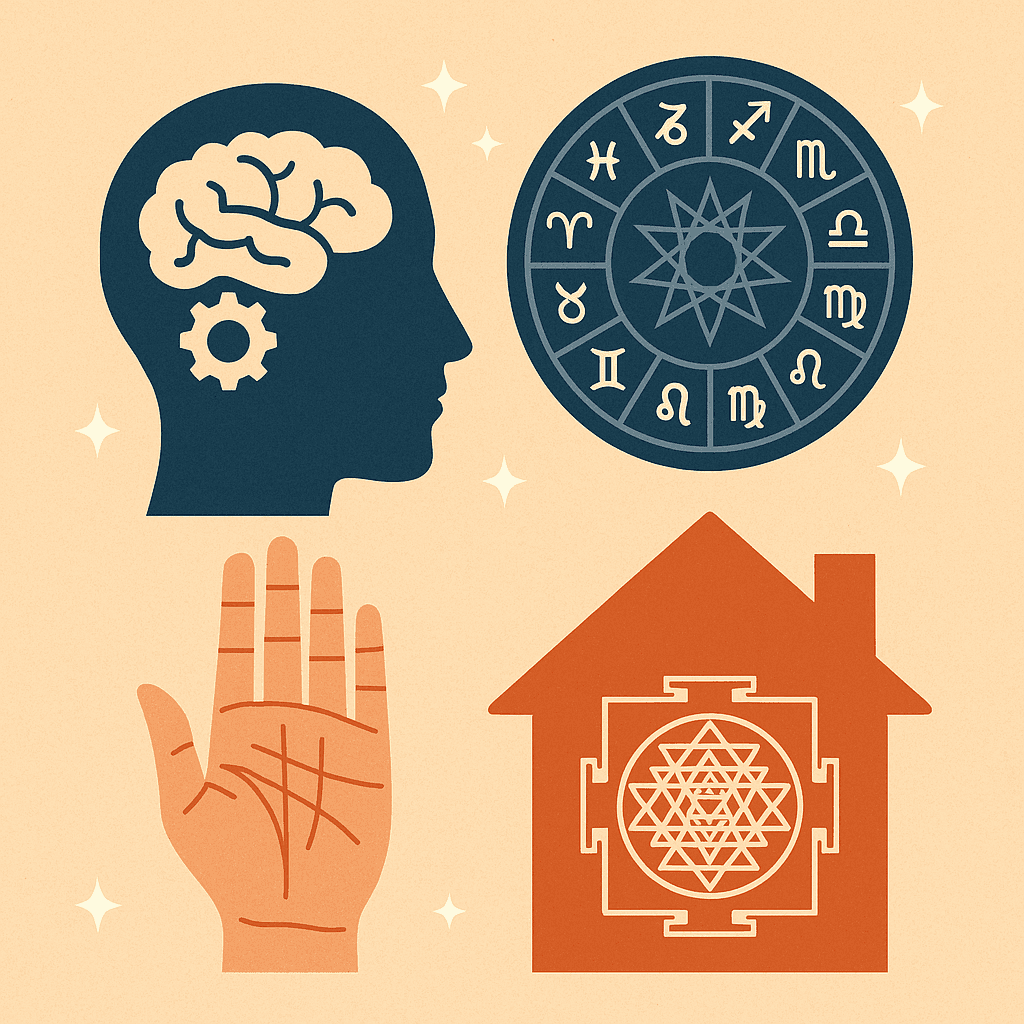
By combining psychology, astrology, and palmistry, we can gain a deeper understanding of why anxiety occurs, how intuition communicates, and how to reconnect with our inner wisdom.
Anxiety: The Mind's Endless Question Machine
Psychology explains anxiety as the brain's attempt to protect us from danger.
The human brain evolved to constantly scan for threats. Thousands of years ago, this helped our ancestors survive physical dangers. Today, however, our brains often treat uncertainty as danger.
A delayed text message becomes a possible rejection.
A career change becomes a potential disaster.
A disagreement becomes the end of a relationship.
The anxious mind starts generating questions:
What if this goes wrong?
What if I make a mistake?
What if they are upset with me?
What if I regret this decision?
What if something terrible happens?
The challenge is that anxiety rarely accepts answers.
You answer one question, and immediately another appears.
This is because anxiety is not truly seeking certainty. It is seeking complete safety.
Unfortunately, complete safety is impossible.
As a result, anxiety keeps us trapped in future possibilities instead of present realities.
Many people are not suffering because of what is happening. They are suffering because of what they imagine might happen.
This is not weakness.
It is simply a very human brain trying to protect you.
The Psychology of Intuition
Intuition operates very differently.
While anxiety asks questions, intuition often makes statements.
It does not sound like:
"What if?"
Instead, it sounds more like:
Something feels off.
This opportunity feels right.
Wait.
Go.
Stay.
Not this.
Notice the difference.
Intuition is usually simple.
It does not provide lengthy explanations.
Psychologists often describe intuition as the brain's ability to process information beneath conscious awareness. Your mind notices subtle details that your conscious thinking may not fully recognize.
These details may include:
Changes in tone of voice
Body language
Behavioral patterns
Emotional inconsistencies
Repeated experiences
Before your logical mind catches up, intuition quietly offers a conclusion.
That is why intuition often feels calm rather than dramatic.
Astrology and the Difference Between Anxiety and Intuition
Astrology offers valuable insight into why some people naturally trust themselves while others become trapped in cycles of worry and overthinking.
The Moon: Your Emotional Mind
In astrology, the Moon governs:
Emotions
Mental wellbeing
Emotional security
Inner reactions
A strong and well-supported Moon often indicates emotional stability and healthy self-trust.
When the Moon is challenged by difficult planetary influences, people may experience:
Excessive worry
Emotional fluctuations
Fear-based thinking
Mood instability
Difficulty trusting themselves
This does not mean anxiety is inevitable. It simply means emotional regulation becomes an important life lesson.
Many highly intuitive people also have sensitive Moon placements. The key is learning whether you are responding from intuition or reacting from fear.
Mercury: The Voice of Thought
Mercury represents:
Thinking
Analysis
Communication
Logic
A strong Mercury gives excellent problem-solving abilities.
However, excessive mental activity can sometimes create:
Overthinking
Analysis paralysis
Constant questioning
Difficulty making decisions
People with strong Mercury influence often try to think their way out of uncertainty.
The challenge is that not every problem can be solved through more thinking.
Some situations require self-trust.
Rahu: Fear, Obsession and Imagination
Rahu plays an important role in modern anxiety.
Rahu magnifies:
Future thinking
Obsession
Fear
Uncertainty
Digital overstimulation
Under strong Rahu influence, people may imagine countless future scenarios that never actually occur.
Examples include:
Assuming the worst without evidence
Overanalyzing messages
Becoming emotionally attached to imagined outcomes
Catastrophizing small situations
Rahu often creates the illusion that every possibility is equally likely.
This can make anxiety feel very convincing.
Saturn: The Return to Reality
Saturn provides balance.
Where Rahu creates fear of the future, Saturn asks:
What are the facts?
What is happening right now?
What action can be taken today?
Saturn helps us distinguish between imagination and reality.
Developing healthy Saturn qualities such as patience, discipline, and practical thinking can significantly reduce anxiety.
What Palmistry Reveals About Anxiety and Intuition
Palmistry offers another perspective on emotional patterns and mental tendencies.
While hands do not determine your future, they often reveal how you process emotions and experiences.
The Head Line
The Head Line reflects thought patterns and mental functioning.
A long Head Line often indicates:
Deep thinking
Strong analysis
Excellent concentration
However, excessive mental activity can sometimes lead to overthinking.
A chained or fragmented Head Line may indicate:
Mental restlessness
Difficulty focusing
Anxiety-related thinking
Emotional stress
A clear and balanced Head Line often reflects practical thinking and better decision-making ability.
The Mount of Moon
The Mount of Moon is associated with:
Intuition
Imagination
Creativity
Emotional sensitivity
A well-developed Moon Mount often indicates strong intuitive abilities.
However, when imagination becomes excessive, it may be difficult to distinguish intuition from fear-based thinking.
This is why emotional grounding is essential.
The Heart Line
The Heart Line reflects emotional processing.
Sensitive Heart Lines often belong to people who:
Feel emotions deeply
Absorb others' feelings
Worry about relationships
Seek emotional harmony
While these qualities create empathy, they can also increase emotional anxiety if healthy boundaries are not maintained.
How to Tell Whether It Is Anxiety or Intuition
One of the simplest ways to distinguish the two is by observing how they feel.
Anxiety
Feels urgent
Creates fear
Demands immediate action
Produces endless questions
Changes constantly
Focuses on future problems
Intuition
Feels calm
Creates clarity
Does not panic
Repeats quietly
Remains consistent
Focuses on present awareness
Anxiety is loud.
Intuition is quiet.
Anxiety chases your attention.
Intuition patiently waits.
The Power of "Even If"
One of the most effective techniques for managing anxiety is replacing "What If" with "Even If."
For example:
Instead of:
"What if I fail?"
Try:
"Even if I fail, I will learn and grow."
Instead of:
"What if they reject me?"
Try:
"Even if they reject me, I will be okay."
Instead of:
"What if everything falls apart?"
Try:
"Even if things become difficult, I have overcome challenges before."
This simple shift changes your focus.
The anxious mind seeks guarantees.
The resilient mind builds confidence in its ability to cope.
You do not need certainty to move forward.
You need trust in your ability to handle uncertainty.
Practical Steps to Strengthen Intuition and Reduce Anxiety
1. Reduce Mental Noise
Constant social media consumption, comparison, and information overload make it difficult to hear your inner voice.
Create intentional periods of silence each day.
2. Write Down Your Fears
When anxiety appears, ask yourself:
Is this happening right now?
What evidence do I have?
Am I dealing with facts or assumptions?
Writing helps separate reality from imagination.
3. Strengthen Emotional Stability
From an astrological perspective, calming the Moon supports emotional wellbeing.
Helpful practices include:
Meditation
Spending time in nature
Walking near water
Gratitude journaling
Healthy sleep routines
4. Practice Hridaya Mudra
From a palmistry and energy perspective, Hridaya Mudra can help calm emotional turbulence and promote inner balance.
Practicing it for a few minutes daily may help reduce emotional overwhelm and improve self-awareness.
5. Focus on What You Can Control
Ask yourself:
What action can I take today?
What is within my control?
What facts do I know?
This helps shift attention away from imagined futures and back to present reality.
6. Trust Consistent Inner Messages
Anxiety changes every day.
Intuition tends to repeat.
If a calm message continues to return over time, it may deserve your attention.
Frequently Asked Questions
Can intuition feel uncomfortable?
Yes. Intuition is not always pleasant. Sometimes it asks us to leave situations, establish boundaries, or make difficult decisions. The difference is that intuition usually feels clear rather than chaotic.
Can anxiety disguise itself as intuition?
Absolutely. Fear often pretends to be intuition. This is why self-awareness and emotional regulation are important.
Does astrology predict anxiety?
Astrology does not predict mental health conditions. It simply highlights emotional tendencies, strengths, and areas where personal growth may be needed.
Can palmistry reveal emotional patterns?
Palmistry can indicate emotional and mental tendencies, but it should always be used as a tool for self-awareness rather than as a fixed prediction.
Final Thoughts
One of the greatest skills we can develop is learning to distinguish fear from wisdom.
Anxiety will continue to ask questions.
What if?
What if?
What if?
But life cannot be lived through endless questioning.
Psychology teaches us how anxiety operates.
Astrology helps us understand our emotional and mental patterns.
Palmistry reveals tendencies that influence how we think, feel, and respond to life's challenges.
Together, they remind us that we do not need to eliminate every anxious thought before moving forward.
The next time anxiety begins creating fearful stories, pause and respond with:
"Even if."
Then become quiet.
Listen carefully.
Beneath the noise, beneath the fear, beneath the endless questions, there is often a quieter voice.
Not asking.
Knowing.
And that voice may have been guiding you all along.
Latest
From the Blog
Discover fresh insights, practical tips, and empowering stories to help you on your journey towards a happier, healthier, and more fulfilling life. Dive into our most recent posts below and embark on a path of continuous growth and self-discovery.